One AI backbone across both systems.

AI Analysis and Targeting Engine

Supports AI-powered multimodal neuroimaging data integration and analysis (MRI, fMRI, DTI, PET/CT), with flexible configuration for advanced research into brain targets and underlying neural mechanisms.

Robotic Navigation and Execution

Delivers 0.9 mm targeting accuracy and 0.15 mm execution repeatability. A 15-second marker-free, contactless registration workflow ensures high consistency across sessions, operators, and multi-site studies.

Simulation-Based Neuromodualtion

Moves beyond conventional fixed-output paradigms by enabling high-precision, patient-specific neuromodulation planning. Simulations are driven by individualised CT and MRI anatomical data and support both ultrasound and electromagnetic stimulation modalities.

Closed-Loop Monitoring

Fully compatible with a broad range of biosignal acquisition systems (e.g., EEG, eye tracking, ECG), and supports flexible implementation of closed-loop feedback paradigms.
Cutting-edge tFUS System

Transcranial focused ultrasound (tFUS) delivers acoustic energy to modulate deep brain nucleus, addressing a key limitation of conventional non-invasive neuromodulation technologies.
Available in 64- and 256-channel desktop research configurations, with optional integration into navigation systems and robotic positioning platforms for neuroscience research and translational neuromodulation studies.
A 1024-channel configuration supports ultra-precise beamforming and multi-target stimulation for high-end research applications.

  • Skull Aberration Correction
    A major technical challenge in tFUS is phase distortion introduced by the skull, which significantly degrades focal accuracy in conventional systems.
    Our proprietary AI-driven correction algorithm compensates for subject-specific skull-induced aberrations based on individual imaging data, achieving ≥95% focal targeting accuracy and a 25–35% overall improvement compared to standard approaches.
  • Deep Brain Access
    Enables targeting of brain structures at depths of approximately 8–15 cm beneath the cortical surface (compared to ~2–3 cm for TMS).
    This capability facilitates investigation of deep brain circuits (e.g., basal ganglia, thalamus) and expands access to a substantial proportion of previously difficult-to-study targets, opening new avenues for research in neuropsychiatric, neurodegenerative, and movement disorders.
  • Unified Platform Architecture
    Built on a shared AI-driven targeting and automatic robotic execution framework with our TMS system, enabling consistent and reproducible workflows across modalities.
    Supports seamless transition between TMS and tFUS research system, with unified data standards, reduced operator training requirements (by 40–50%), and significantly improved experimental efficiency.
  • Rapid Customisation and Development Support
    Provides fast, end-to-end customisation across transducer design, accessory development, and software integration. Supports application-specific configurations, from tailored transducer architectures to matched accessories and customised software workflows, enabling efficient adaptation to diverse research requirements.

Interested in leveraging our tFUS platform for your neuroscience research? Let’s connect—we’ll walk you through our proprietary technology, demonstrate how it fits your specific research goals (preclinical/human, specific brain regions), and share case studies of labs using our system to advance their work.

Contact Us

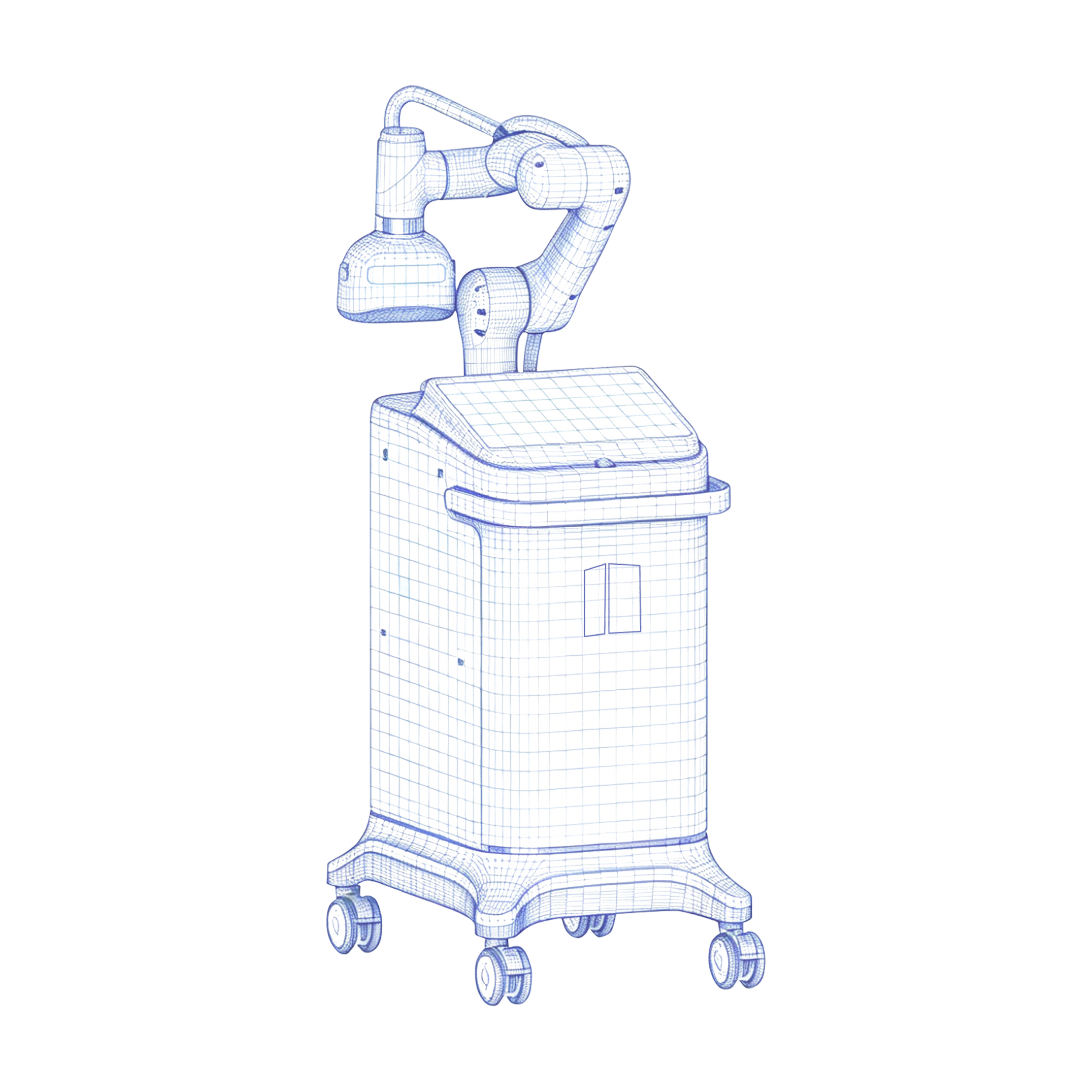
AI-Robotic TMS System

Transcranial magnetic stimulation (TMS) uses time-varying magnetic fields to non-invasively modulate cortical circuits. Our AI-driven robotic TMS platform is designed for research and clinical environments requiring high precision, reproducibility, and personalised neuromodulation.

  • Integrated Design for Superior Traceability & Reproducibility
    All critical stimulation parameters—including coil position, orientation, and pose—are continuously tracked, recorded, and ensure reproducibility across sessions.
    A self-developed high-performance coil and power delivery system enables deep yet focal stimulation with programmable pulse parameters, supporting advanced research protocols and full traceability for rigorous scientific and clinical applications.
  • Automated and Standardised Operation
    Supports fully automated motor evoked potential (MEP) measurement (~2 minutes) and marker-free, contactless registration (~15 seconds) with sub-millimeter accuracy.
    The robotic positioning system achieves 0.9 mm targeting accuracy and supports user-defined stimulation targets and sequences, including TTL-triggered paradigms.
    These capabilities reduce operator-dependent variability, improve workflow efficiency, and ensure consistent and accurate stimulation delivery.
  • Simulation-driven Optimisation
    Incorporates AI-driven algorithms that integrate subject-specific imaging data with electromagnetic field simulation. This enables precise targeting and stimulation parameter optimisation, reducing off-target effects while improving neuromodulation specificity and efficacy in both research and clinical settings.

Interested in our TMS platform for your research or clinical program? Get in touch and we will walk you through the details.

Contact Us